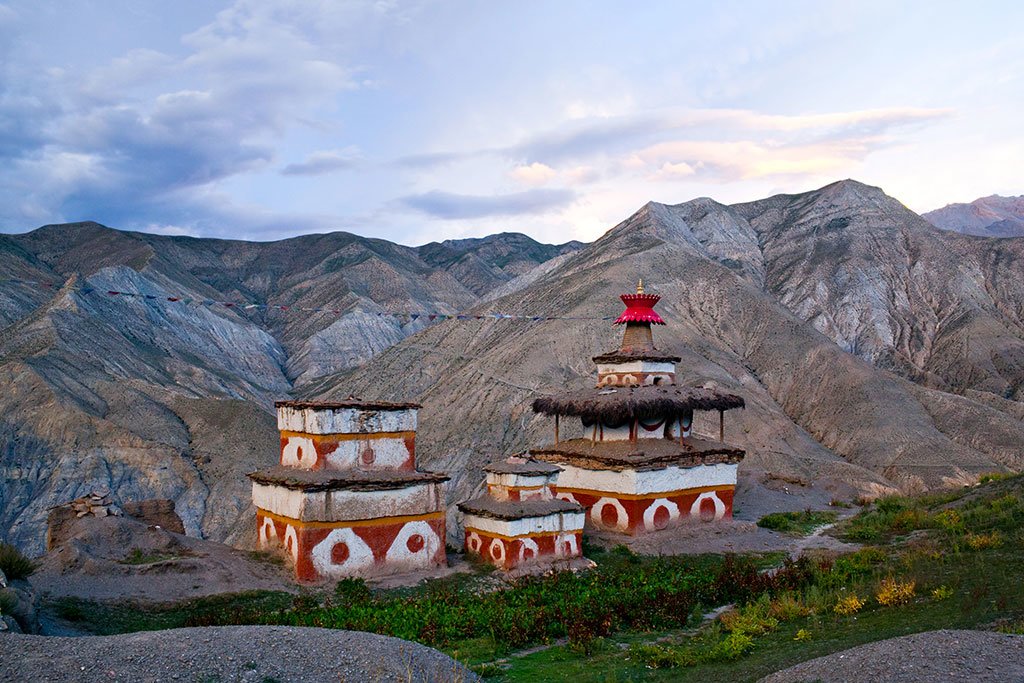
Upper Dolpo Trek
The Upper Dolpo trek is a challenging and less explored trekking area in Nepal that takes you through the rugged and wild landscapes of the Dolpo region. Situated between the Tibetan plateau and the Dhaulagiri Himalayan range, the trek is considered one of the most remote treks and offers a true wilderness experience.
The Trek to Upper Dolpo starts right after you land in Juphal, a small hill town in the Dolpa region, and takes you through traditional Tibetan villages such as Rigmo, Saldang, and Dho Tarap along with the spectacular landscapes.
Itinerary
Once you arrive at Kathmandu's Tribhuvan International Airport, a member of Ganesh Tours and trekking team will be there to welcome you and help you to transfer to your hotel. After checking in, you can take some time to relax. Later in the evening, we will gather for a welcome dinner to kick off our journey.
After breakfast, we will gather to discuss and plan our Upper Dolpo trek. In the afternoon, we will take a flight to Nepalgunj, a major city in the southern lowlands of Nepal that lies just 8 kilometers from the Indian border. In the evening you can take a ride on a cycle rickshaw to explore the area. We will spend the night at a hotel in Nepalgunj.
Today, we will have an early morning flight from Nepalgunj to Juphal. The sight of the snow-capped mountains from the airplane along the flight is amazing. While just a gravel airstrip amidst the mountains, the Juphal Airport is a welcoming sight. From Juphal, we will walk down a small path among wheat fields to the Thuli Bheri River. Further on, the path then leads to Dunai. Overnights stay.
Dunai Bazar is situated on the bank of the Thuli Bheri river, we start our hike alongside of the Bheri river. The trek today is mostly uphill and gradual and we must cross a few suspensions bridge over the Phoksundo river. After 6 hour's hike, we will reach our today destination, Chhepka a tiny village in mountains.
After breakfast, we start our hike on the gradual trail alongside the river through the forest. Today most of our trek goes on an up-and-downhill uneven trail and we need to cross small bridges. After a three-hour hike, we can reach a small place called Raichi, where we can take our lunch break. We continue our hike to Chunuwar which will take about 2 hours. Chunuwar is a small town before Phoksundo Lake, where we can visit the year's old monastery and wander around. Overnight in Chunuwar.
Today, we will make our way toward one of the most impressive highlights of the trek: Phoksundo Lake, which happens to be one of the deepest lakes in Nepal. The trail to reach Phoksundo is mainly uphill. After a 20-minute hike on the smooth gradual trail, the path becomes steep as we climb further up.rnrnAfter a two-hour uphill climb, we will reach a viewpoint that offers stunning views of the highest waterfall in Nepal, breathtaking mountains, and landscapes. From the viewpoint, it takes another 10-minute uphill walk to catch the first glimpse of Phoksundo lake. The trail descends and smooths as we pass through a pine forest before reaching the small Sherpa village of Rigmo. We will set up camp by the side of Phoksundo Lake, and after lunch, we will explore the lake and visit the nearby monastery. We will spend the night in Phoksundo.
Phoksundo Lake is a boundary between the Upper and Lower Dolpo, from today we enter into the restricted area of Dolpo. We hike on the salt trading route that is used by local and Tibetan people. Hiking on the side of a beautiful lake with a surrounding mountain view will be an amazing experience. This will be the best part of the trek.rnrnThe first part of the trek will be on a gently ascending path. After an hour and a half of hiking, we'll arrive at one of the most magnificent vantage points, offering a breathtaking view of the mesmerizing landscape of Dolpo, including the strikingly blue Phoksundo Lake and the awe-inspiring mountainous vista. We'll continue our journey, following the trail that leads us to the opposite side of the lake where we'll pause for lunch. Post-lunch, we'll need to trek for another two hours to arrive at our destination for the day.
After breakfast, we embarked on our trek through the pine forest alongside the river. The weather was turning cooler, providing a scenic view of the mountains. As we crossed the river, we entered through a narrow rocky passage flanked by towering walls on both sides, eventually leading us to a stream that we had to cross several times during our hike.rnrnAfter three hours of hiking, we'll arrive at a spot beside a brook, where we'll break for lunch. Following that, we'll need to trek for another hour and a half to arrive at Kang La Base Camp, an expansive area near a small stream. We'll spend the night at the base camp.
Today is going to be a demanding day as we'll need to cross the Kang-La Pass (5350m) and trek a long distance. The initial leg of our journey will be an exhausting ascent, and the high altitude may add to the difficulty. After two hours of climbing, we'll eventually reach the top of Kang-la pass. The steep descent will require us to walk for 4-5 hours to arrive at Shey Gompa. The glimpse of the Himalayas and the arid mountainous terrain is awe-inspiring. We'll spend the night at Shey Gompa.
Today is our first rest day at Shey Gompa. We can visit the century-old monastery, explore the crystal mountain, and relax our day in this beautiful mountain land.rnrnThe Shey monastery hosts a summer festival known as the Shey festival which is most popular among Buddhist followers. The Upper Dolpo and Shey Gompa is well explained in the book u201cThe Snow Leopardu201d written by Peter Matthiessen and pictured in a movie called u201cCaravanu201d by Eric Valli.
Today we must cross another high pass (5000m) named called Shey-La. The trek around the upper Dolpo valley and encounter with Local sherpa people, yaks, mountain goats, and other wildlife is simply an amazing experience. The first 2 hours of the trek go on a gradual climb, when we reach the top of Shey-La, the trails continue down on dry mountain land. After 4 hours of hiking, we will reach Namgong Gompa, a small salter beneath the mountain nearby a monastery that is set on a high cliff.
Todayu2019s trek will be short and easy compared with the last two one. The trail is wider and gradual, the first 40 minutes will be a steep climb and after that, the trek goes mostly on downhill.rnrnSanding is the largest village in the Upper Dolpo region and the route to Tibet for trade. This beautiful village is surrounded by wonderful hills, and it has wide farmland as well. After our lunch, we will explore the village. Here, people follow the ancient Amchi Buddhist tradition. The lifestyle of locals is highly influenced by Tibetan culture and tradition.
Today we start our trek through the Sandang village, we walk down to the monastery and take a short visit and continue our hike through the terrace field, stupa, and mane walls. Today we hike mostly on a gradual trail, along the way we pass through several Sherpa villages and experience their lifestyle and warm greeting. Along the way, we must cross the knee-deep river several times and we will camp on the small open ground surrounded by high mountains and thorny Juniper bushes.
Today, our journey leads us to the base of the Last high pass. Our hiking trail follows the river, which we'll need to cross multiple times, freezing water without proper footwear. We'll stop for a lunch break before attempting on, traversing through the alpine vegetation. The last leg of our trek is the most demanding, involving a gradual uphill climb for an hour. However, we'll have the opportunity to relish the picturesque landscape that envelops us. Our stop for the night is Jyantala Base Camp.
After breakfast, we start our journey to Jyanta-La Pass on a steeply uphill trail which will take about an hour. From the top of the Pass, we can see the breathtaking Himalayan scenery including mount Dhaulagiri (8167m) and the barren lands of inner Dolpo. The trail goes all the way down and gradually to the Tarap valley. After two hours walk from our lunch place, we will reach the beautiful town of Tokyu.
Hiking down to the lower land will be easier than climbing a high mountain. Today we took a short hike to Dho Tarap on a nice and flat gradual road. Dho village is one of the biggest and highest villages in Lower Dolpo and from here the route to Jomsom, Mustang, and Tibet separates. Overnight in Dho Trap.
After a long hike around the high Himalayas, our bodies need some rest. Today is our rest day at Dho village, we take a rest and relax our bodies. We can take a short walk around the Dho village and visit the Monastery. Overnight at Dho.
The trail today goes all the way downhill to Nawar Pani in a wide gorge alongside the Trape river. We will cross the river multiple times, and along the trail, we can encounter mules, horses, and yaks as they use as transportation. And we may have a chance to see some wildlife such as Musk deer and Himalayan Thar. Nawar Pani is a small place on the bank of the river where we can set out the tent and spend the night.
As we move forward, our route mostly follows the river, leading us up and down on uneven trails. The temperature will rise, and the trek will become easier as we descend. Along the way back of our journey, we had plenty of opportunities to enjoy the breathtaking views of the river and waterfalls. However, one hour before reaching Linda Odar, we'll come across a steep, dusty, and gravelly path that demands our undivided attention. Our lodging for the night is at Linda Odar.
Today the first part of the trek will be on a steep downhill. We cross the suspension bridge, check our entry permit, and continue our trek to Tarakot on a wide and gradual road. Along the way, we will meet and be greeted by local people, and enjoy the terraced farmland and the view of the mountains. After 2 hour hike from the lunch stop, we will reach our destination.
Trekking to Dunai will be easier on a gradual incline. After we cross the suspension bridge, we walk on the newly constructed road along the shore of the Thuli Bheri river. The 5 hours hike will reach us at Tarakot, the district headquarters of Dolpo. In the evening we can wander around the town. Overnight in Dunai.
Today is the final day of our long journey around the Dolpo region. After breakfast, we started our hike to Jhuphal mostly on the wide rode. The final part of the trek will be more challenging on steep climbs on narrow trails. Today we say goodbye to most of our crew members. overnight stay in Juphal.
Early in the morning, we will fly to Nepalgunj from Juphal. And we can get a connecting flight to Kathmandu in the afternoon. In the evening, we can enjoy our farewell dinner.
The 3-week long journey around the Dolpo region, Nepal came to an end today. Until next say goodbye to our friends. Ganesh Tours & Trekking will arrange the airport departure. Have a safe flight back home and keep in touch for your upcoming adventure with us.
Included / Excluded
- Permits & Registrations: National park entries, conservation area permits (ACAP/MCAP), restricted area permits, and TIMS cards.
- Transport: Standard ground transportation (private jeep/tourist bus) or domestic flights as specified in the specific trek itinerary.
- Accommodation: Twin-sharing tea houses/lodges during the trek and standard hotel accommodation during city transits.
- Meals: Full-board meals (Breakfast, Lunch, and Dinner) featuring local, Indian, and Western alpine options during the trek.
- Guiding Team: Government-licensed, first-aid trained local English-speaking guide and experienced baggage porters.
- Safety Net: Emergency first-aid kit, high-altitude pulse oximeter, and arrangement coordination for emergency helicopter evacuations.
- Visas & Flights: International airfare and Nepal entry visa fees.
- Insurance: Comprehensive travel, medical, high-altitude rescue, and helicopter evacuation insurance (Mandatory).
- City Dining: Lunches and dinners in Kathmandu and Pokhara.
- Trail Conveniences: Hot showers, electronic device charging fees, Wi-Fi access, and satellite communication use.
- Beverages: Bottled mineral water, specialty coffees, soft drinks, and all alcoholic beverages.
- Personal Gear: Trekking equipment (boots, down jackets, sleeping bags) and personal medical kits.
- Gratitude: Tips for the trekking guides, drivers, and porters.
Ganesh Pandey
Tour Guide